As an Amazon Associate I earn from qualifying purchases.
To clean a cat fountain pump, unplug the fountain, remove the pump only as the manual allows, and clean its impeller and cavity using the manufacturer’s procedure. Keep powered bases and control modules away from rinse water. The exact parts you can remove, whether any parts are dishwasher-safe, and how often to clean them all depend on the fountain model. [S1][S2][S4]
The steps below compare official PetSafe Drinkwell and PETKIT instructions. They are examples, not one universal procedure for every fountain.
Contents
- Before you remove the pump
- PetSafe Drinkwell pump example
- PETKIT base and pump limits
- Reassemble and check water flow
- Frequently asked questions
Before you remove the pump
- Disconnect power. Unplug the fountain before draining or disassembling it. Do not handle a powered pump near water. PetSafe’s cleaning directions begin by unplugging and emptying the fountain. [S1]
- Identify the model. Find the model name or number on the fountain and open its current manual. A pump that looks similar may have different clips, seals, or electrical connections.
- Separate washable parts from powered assemblies. Put removable water-contact pieces aside only if the manual lists them as removable. Do not immerse a powered base, cord, or control module unless the maker explicitly says it is safe. PETKIT’s CT-W3 manual specifically says not to rinse or soak its wireless base or control module. [S4]
- Use only the stated cleaner and tools. Do not assume vinegar, bleach, lubricant, boiling water, or a dishwasher is appropriate. Procedures differ by model and material.
PetSafe Drinkwell pump example
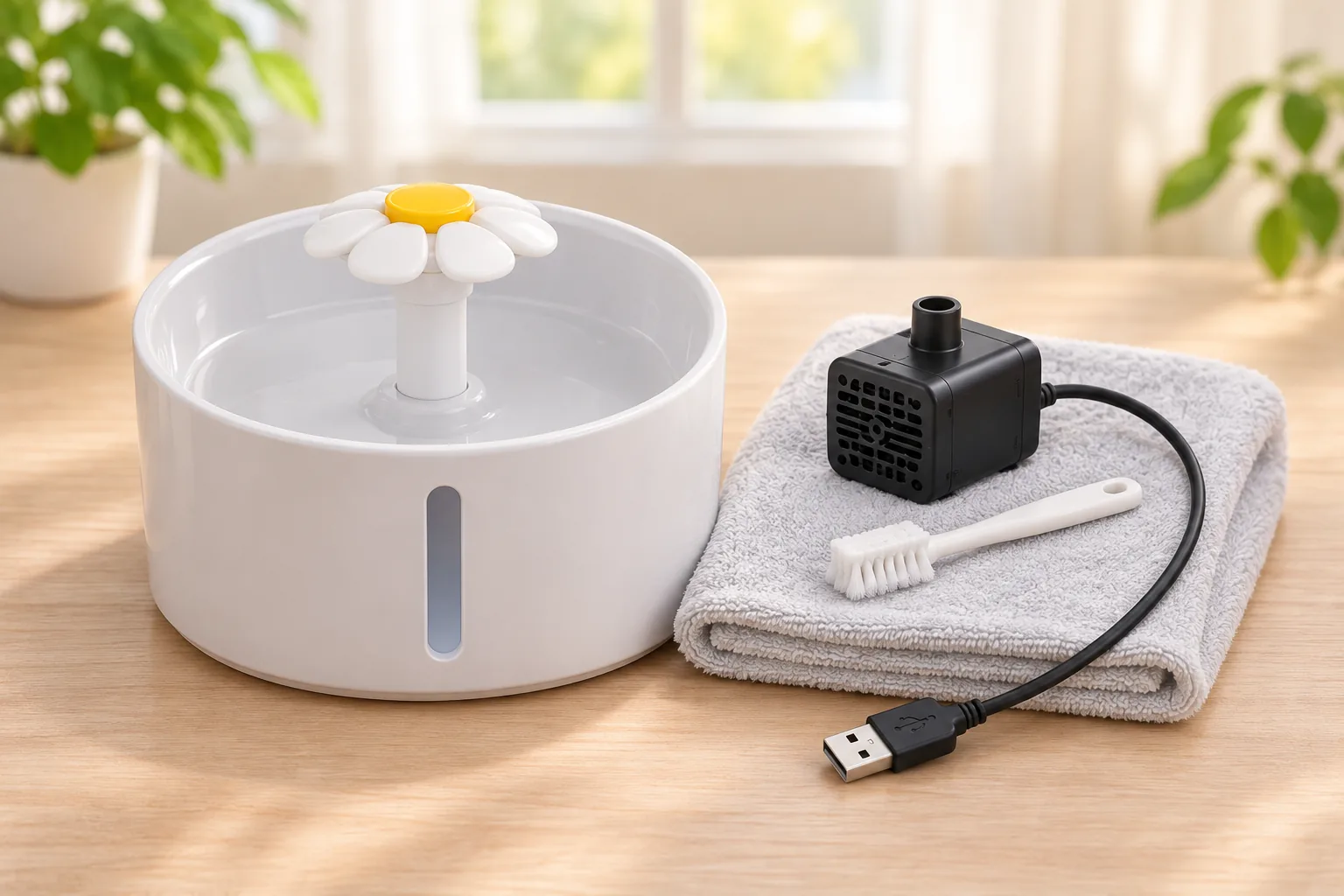
For the Drinkwell procedure described by PetSafe, remove the motor from the unplugged fountain, then lift out the impeller after removing its cover if present. PetSafe says the impeller can collect hair and debris; its instructions show cleaning the impeller and motor cavity with soapy water and a small brush, then rinsing parts well before reassembly. Follow the page for the particular Drinkwell fountain you own. [S1]
PetSafe’s separate pump support page describes a sequence of removing the pump faceplate, pulling out the stator, and lifting out the magnet-held impeller. That parts sequence applies to the pumps covered by that help page; do not force a component that does not release as described. For that PetSafe procedure, the manufacturer specifies mild dish soap and warm water. It also gives a 50/50 water-and-white-vinegar soak for mineral buildup and says not to use bleach or other harsh chemicals. Those chemical directions are PetSafe’s pump procedure only; do not transfer them to a different brand or model. [S2]
The fountain cleaning page also has exceptions: it excludes the motor and cord from its dishwasher guidance, and says Avalon and Pagoda filter housings are hand-wash only. Check the exact fountain’s instructions before putting any part in a dishwasher. [S1]
PETKIT base and pump limits
The PETKIT EVERSWEET MAX (CORDLESS), model CT-W3, separates its wireless pump and water-contact components from the wireless base and control module. Its manual warns not to rinse or soak the base or control module. Remove and clean only the parts that the CT-W3 manual identifies, and reinstall the pump and outlet pipe in their stated positions. [S4]
PETKIT’s EverSweet Solo 2 (P4114) manual also cautions against immersing its base. This is another example of why a fountain’s outside surfaces do not tell you which internal assemblies can be washed. Use that model’s manual for its disassembly and cleaning sequence rather than copying the Drinkwell steps. [S5]
For maintenance frequency, PetSafe lists cleaning the Platinum pump every two weeks as guidance for that specific replacement pump/fountain context. PETKIT CT-W3 also gives its own tank and thorough-cleaning schedule. Neither schedule is a universal interval for all fountains; follow the manual for your unit and inspect it at the intervals the maker specifies. [S3][S4]
Reassemble and check water flow
Before reconnecting power, rinse the parts that the maker says to rinse and make sure they are seated in their original positions. Check that the outlet pipe and pump are installed as shown in the manual, fill the fountain to its indicated level, and keep plugs and powered parts dry. If the pump makes an unusual sound, does not start, or still has weak flow after correct cleaning and reassembly, unplug it and consult the model support page. Cleaning cannot be assumed to repair a worn or failed pump.
For related model help, see our PetSafe Drinkwell Pagoda model guide, replacement pump compatibility guide, and WOPET fountain overview. These help identify models or parts; use the manufacturer manual for cleaning steps.
Frequently asked questions
How often should I clean a fountain pump?
Follow the interval in the exact model’s manual. PetSafe lists every two weeks for its Platinum replacement pump, while other fountain instructions may set different tank or deep-clean intervals. Do not assume the PetSafe interval applies to another pump. [S3][S4]
Can I put a fountain pump in the dishwasher?
Do not put the pump, motor, cord or base in a dishwasher unless that exact model’s manual expressly permits it. PetSafe’s general Drinkwell cleaning directions exclude its motor and cord, and specify a hand-wash exception for Avalon and Pagoda filter housings. [S1]
Can I soak a fountain pump in vinegar?
Only if the instructions for your pump say to. PetSafe describes a vinegar-water soak for mineral buildup in its covered Drinkwell pump procedure, but that is not a general rule for other brands or electronic assemblies. [S2]
What if the pump still has low flow after cleaning?
Confirm that all model-specific parts are seated and the outlet path is clear. If the problem remains, unplug the unit and consult the manufacturer; the research here does not establish that cleaning can restore a failed pump.